A symbol of fertility and a forager’s delight, Crab apple trees are associated with love and marriage and its small, hard fruits make an exquisite, jewel-coloured jelly.
Crab Apple have been significantly over recorded mainly because Apple Malus Domestica has been misidentified as Crab Apple. The national picture is probably reflected within the Isle of Wight and older records of Crab Apple need to be reviewed. However, in the case of the Crab Apple trees at Palmers, the trees are within the boundary of the remnants of Blanket Copse, on the Motkin Boundary and adjacent to the Wild Service Trees.
Consequently, these trees are highly likely to be native remnants Malus sylvestris of a formerly more widespread population.
The distinction is important but can be surprisingly difficult because Malus domestica, the cultivated apple, frequently establishes itself in the countryside after growing from discarded apple pips or spreading from nearby gardens and orchards. The two can also hybridise, producing trees with a mixture of characteristics.
So, what makes a wild crab apple different?
At first glance, Malus sylvestris can look very similar to an ordinary apple tree. However, several features can help distinguish the two.
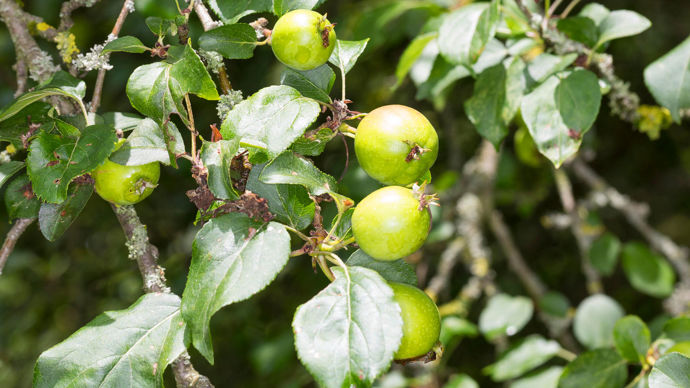
Leaves are one of the most useful clues. Mature leaves of Malus sylvestris are generally relatively small and have a glossy appearance. Most importantly, the underside of a mature leaf is typically hairless. In Malus domestica, the underside of the leaf is generally much hairier, particularly around the veins
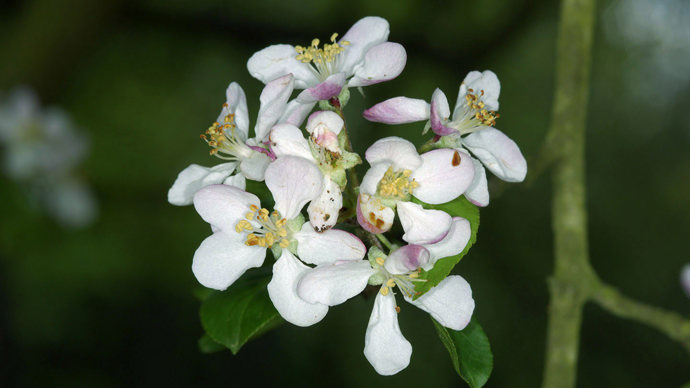
Further identification can be found round the flower stalks and calyx can provide an even stronger indication. A true wild crab apple normally has hairless flower stalks and a hairless outer calyx.
Thorns are another useful feature. Wild crab apple often develops spiny or thorn-like twigs, whereas cultivated apple generally lacks spines.
The final clue is in the fruit produced. Wild crab apples are normally small, rounded, yellow-green apples, commonly around 2–3cm across. They can sometimes develop a reddish flush. Cultivated apples are generally much larger and show a far greater range of colours and forms.
Mature trees can grow to around 10m in height and can live up to 100 years. They have an irregular, rounded shape and a wide, spreading canopy. With greyish-brown, flecked bark, trees can become quite gnarled and twisted and the twigs often develop spines. This ‘crabbed’ appearance may have influenced its common name, ‘crab apple’. The crab apple is also one of the few host trees to the parasitic mistletoe, Viscum album, and trees are often covered in lichens. Its fruits provide food for wildlife while spring blossom is an important source of nectar and pollen for insects.